
The median product engineer should reason about applications as composites of
high-level, functional Lego blocks where technical low-level details are
invisible. Serverless represents just about the ultimate abstraction for this
mindset. Consider AWS
Lambda’s elevator
pitch: “you organize your code into Lambda functions [which run] only when
needed and scale automatically. You only pay for the compute time that you
consume”. Engineers can get away without paying attention to infrastructure,
resource allocation, runtime management, cost optimization, or similar concerns
just like they don’t worry about CPU cache coherency algorithms or the electric
grid .
And yet, despite an appealing value proposition, the industry pivot to
serverless compute as the default architectural pattern for cloud
applications, hasn’t really happened. As AWS Lambda turned
10
last November, Will Larson
posted:
Something I’m still having trouble believing is that complex workflows are
going to move to e.g. AWS Lambda rather than stateless containers orchestrated
by e.g. Amazon EKS. I think 0-1 it makes sense, but operating/scaling
efficiently seems hard. […]
The scepticism seems well justified. In 2023 Datadog
reported serverless
adoption growing between 3-7% among the major cloud providers, with over
50% of their customers using some version of it. However, there is a
long way from “we use lambda” to “our complex workflows are all
serverless”, and the growth rate seems too incremental to make the case
that an exodus is on the way. The general trend of software eating the
world is a simpler
and more reasonable explanation for that level of growth, especially
with AI putting downwards pressure on the cost and cognitive overhead to
generate small pieces of purpose-specific code (a sweet spot for
serverless). Otherwise, the figures don’t really signal a mass
migration.
What are the sources of friction against serverless?
In this piece will discuss two factors. First, fatigue from the last
paradigm shift to microservices (a term I’ll use as shorthand for
architectures based on small, loosely coupled services with bounded
contexts). That transition was much harder than expected because of
immaturity in tooling, infrastructure, but also a critical gap between
technical and organizational readiness. Second that, while some might
consider that the industry is being too conservative, caution is in fact
reasonable because serverless will exacerbate the same type of
challenges that were created by microservices (many of which are still
not fully resolved).
The post-traumatic syndrome of microservices
A technological trend can be directionally correct, but direction says
little about timing, which is where most people get burned. Early
adopters share part of the industry bill for maturing a technology, so
in a way, every migration implies a bet that the cost / benefit ratio
will work out either because the maturity gap is already small enough,
or because the new technology will provide outsized benefits.
Microservices made a canonical example of how easy it is to miscalibrate
that bet. Since the trend started ~15y
ago, these
architectures proved effective to solve real problems of scale,
reliability or productivity. But also showed a heavy reliance on
load-bearing infrastructure and organizational competence that didn’t
exist back then. FAANGs and service providers subsidized tooling and
infrastructure. The rest of the industry paid out of their own pocket
for the real-world projects where solutions were tested on the longer
tail of use cases and a generation of engineers were trained on
them. (Make your own estimates on what % of tech industry funding
may have gone to “break the monolith” projects alone.)
The positive side of the microservice bubble was that it socialized the
cost of maturing the technology. In 2025 we enjoy a collective knowledge
base of benefits, trade-offs, risks and, especially, contraindications
(knowing when not to use a technology is a good marker of maturity,
and it’s significant that only in the last couple of years it became
acceptable to say that a monolith is usually a better starting point).
The negative side was that, in retrospect, many organizations would have
preferred to opt-out of the battle testing part, and wait at the boring
side of the adoption curve.
The serverless trend may very well be directionally correct too. But a
technical decision maker considering to sponsor a migration will be
justifiably worried about miscalibrating that bet and underestimate the
pending cost to bridge the remaining maturity gap. With microservice
scars still fresh, and immersed in a
post-ZIRP
economic environment, this is already a risky proposition.
Where is the complexity of moving into serverless?
Load-bearing infrastructure
A naive mental model for the transition to serverless involves laying
each microservice in the chopping board and fragment its constituent
logical components into a collection of smaller functions. At a high
elevation this makes no fundamental change: a functional Lego block is
conceptually the same whether it’s implemented as an endpoint in a
microservice or a lambda function. But so are an electric and a
combustion car conceptually the same, at least until you’re trying to
refuel.
High-level abstractions are always supported by load-bearing
infrastructure which may (and should) be invisible, but is never
irrelevant. The transition to electric cars depends on adapting or
rebuilding the energy distribution network that is taken for granted in
combustion cars. The transition to microservices depended on providing a
new stack of technical infrastructure to solve distributed systems
problems that emerged as soon as communication between Lego blocks took
place over the network instead of a motherboard (to wit: on-wire
formats, latency, reliability, data integrity, service discovery,
deployment, observability, troubleshooting, etc.). In a similar way,
fragmenting a microservice into lambdas implies a leap away from a
significant part of of the previous load-bearing infrastructure.
A basic example are dependency injection frameworks like
Dagger, Google
Wire, Uber
FX, or Spring
Boot,
which simplify wiring up dependencies among the handful of internal
components that make up a typical microservice. After those components
fragment into a collection of lambdas, the scope expands from a narrow
problem of bookkeeping local references within a process, to one of
orchestrating cloud resources using raw cloud APIs.
Similar conversations appear in many other domains besides application
frameworks: observability, continuous delivery, etc. Piggybacking on
tooling and infrastructure for stateless architectures is insufficient
to support large serverless ones. Building purpose-specific abstractions
to fill those gaps makes for interesting engineering challenges, but any
decision maker considering a migration to serverless will rather see
them as an inconvenient liability, with uncertain cost, and with too
many odds of locking down engineering capacity that might be better used
for revenue-generating purposes.
Organizational readiness
Closing technical maturity gaps is not just a matter of building tools,
but also rewiring individuals and organizations to deploy them
effectively. Back in the 2010s, Netflix became one of the key referents
in applying microservices at scale in good part thanks to open sourcing
a vast portfolio of internal tools and
infrastructure. Their cloud architect at
the time, Adrian Cockcroft, said in a 2023 microservice
retrospective:
“maybe […] we came up with stuff and we shared it with people and a few
people took it home and tried to implement it before their organizations
were really ready for it.”
Most organizations have appetite for speed and growth. But introducing a
technical innovation that optimizes for scale, speed, and productivity
puts pressure on the organization to keep up and renegotiate trade-offs
around decision-making structures, communication dynamics, operational
capabilities, risk tolerance, quality standards, and similar factors to
stay aligned with the purely technical aspects.
In my experience, this organizational readiness has a significant lag
that manifests most often in delivery pipelines. Nowadays it’s easy to
find technical systems that look on the whiteboard like the canonical
fabric of independent, decentralized services on top of a bingo
card of modern tooling. But
behind the surface many conceal monolithic delivery processes where
supposedly autonomous teams are forced to parade changes in lockstep
through a byzantine, maintenance-heavy via crucis of ”dev”, “staging” or
“pre-prod” environments where broad test suites validate each change
against the entire system before it reaches production. This model has
obvious scalability problems that cancel most of the potential of
microservice architectures (and sometimes make things worse). But
getting the broader organization to buy into other ways of planning,
developing, testing, delivering and operating complex distributed
systems is tough.
Serverless amplifies the challenges of microservices
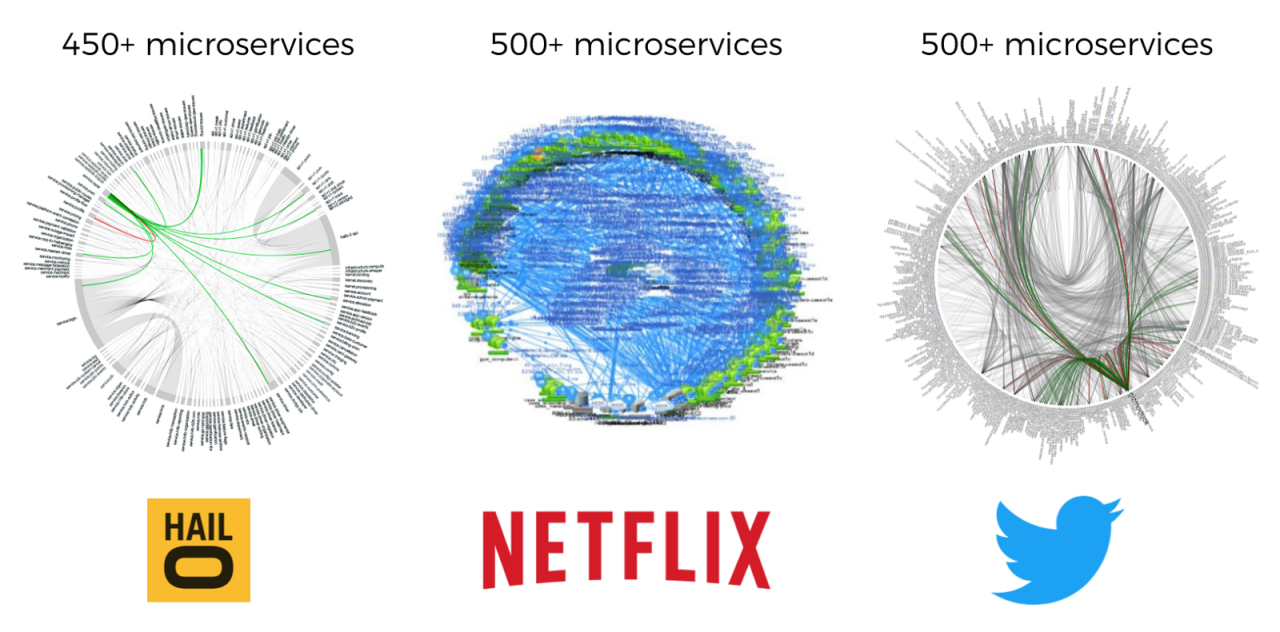
“Death Star” diagrams were commonly used in the early 2010s represent
the increased complexity inherent to microservice architectures. If
serverless implies that each one fragments further into hyper granular
lambda functions, then the application becomes a Death Star of Death
Stars, which is bound to exacerbate the same problems that the industry
has been grappling with for the past ~15 years. Technical ones might be
solved through sheer investment in tooling and infrastructure, but fewer
organizations are willing to take an unbounded share of that cost.
Rewiring individual and collective mental frameworks that can deploy and
operate them effectively will take much longer.
What are effective vectors for serverless adoption?
Head winds may mean that wholesale migration of workloads is unlikely to
happen in the short-medium term. This does not mean that serverless
lacks a solid value proposition (Simon Wardley has articulated the
case a
few
times), so it is still worth
finding adoption vectors that allow for selective, low-risk, incremental
steps. My blueprint is basically this:
- Focus on domains owned by fully autonomous teams, who are already
fluent in developing, deploying, testing operating all their software
independently from the rest of the rest of the organization, and where
product stakeholders are equally comfortable with that autonomy. - Migrate existing workloads that have well-scoped, self-contained
logic, don’t need complex state management, have low to mid-level
traffic and bursty profiles that fit well with cost / performance
trade-offs of serverless (that paragraph serves as a prompt into your
favourite LLM, which should spit out some combination of event-driven,
background tasks, glue for lightweight orchestration, user
authentication flows, etc.) - AI and LLM Integrations deserve their own category. As I mentioned
above, these pretty much satisfy all the above properties, tend to
appear in a more experimental context and drag less legacy
dependencies. With AI Agents shaping to be the trending topic of 2025,
the type of architecture described in Anthropic’s “Building effective
agents”
lends itself well to composites of small bits of business encapsulated
in functions.
I will close highlighting a central argument in Simon Wardley’s case for
serverless:
The future is worrying about things like capital flow through your
applications, where money is actually being spent and what functions,
monitoring that capital flow, tying it to the actual value you’re
creating […] All of a sudden, we’ve got billing by function, we can look
at capital flow in applications, we can associate value to the actual
cost.” (source)
To the extent that the main incentive for broad serverless adoption is
not technical, but financial, so the sponsor is unlikely to come from
the engineering department. This has non-trivial implications, but I’ll
leave that for another time.
Any thoughts? send me an email!


