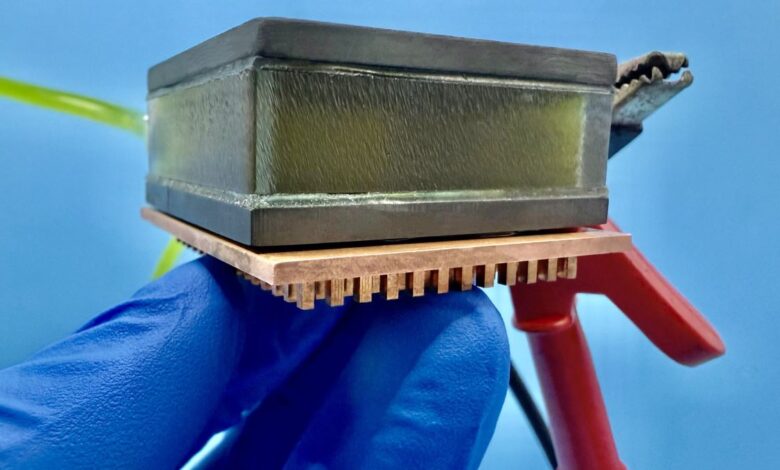
Researchers have developed a technology that they say could make more efficient and eco-friendly refrigerators.
While it can only nudge things a degree or two right now, the researchers believe their method could easily be scaled up.
The technique, described in a paper in Joule, uses a tool called a thermogalvanic cell.
“Thermogalvanic technology is on its way to our lives, either in the form of clean electricity or low-power cooling, and both research and commercial communities should be paying attention,” says senior author Jiangjiang Duan, from the Huazhong University of Science and Technology in China.
Thermogalvanic cells normally work by using heat to prompt a chemical reaction that makes electricity.
It’s theoretically possible to reverse this reaction – using electricity to remove heat – but until now, researchers have struggled to make it work well enough to be useable. Prior to this research, the team says the most efficient cell could only cool things down by 0.1°C.
“While previous studies mostly focus on original system design and numerical simulation, we report a rational and universal design strategy of thermogalvanic electrolytes, enabling a record-high cooling performance that is potentially available for practical application,” says Duan.

Duan and colleagues’ study uses charged iron atoms. The atoms absorb heat when they gain electrons via electricity, and release heat into a heat sink when they lose them.
The team trialled different substances to provide and dissolve the iron atoms, landing on a chlorine-containing iron salt, and a solution of nitrogen and carbon-based compounds called nitriles, as the most effective.
They could cool the system by 1.42°C – which, while modest, is a big improvement on the 0.1°C managed by other techniques.
“Though our advanced electrolyte is commercially viable, further efforts in the system-level design, scalability, and stability are required to promote the practical application of this technology,” says Duan.
“In the future, we aim to continuously improve the thermogalvanic cooling performance by exploring novel mechanisms and advanced materials.
“We are also attempting to develop diverse refrigerator prototypes towards potential application scenarios and are seeking to collaborate with innovation companies to promote commercialization of thermogalvanic technologies.”